
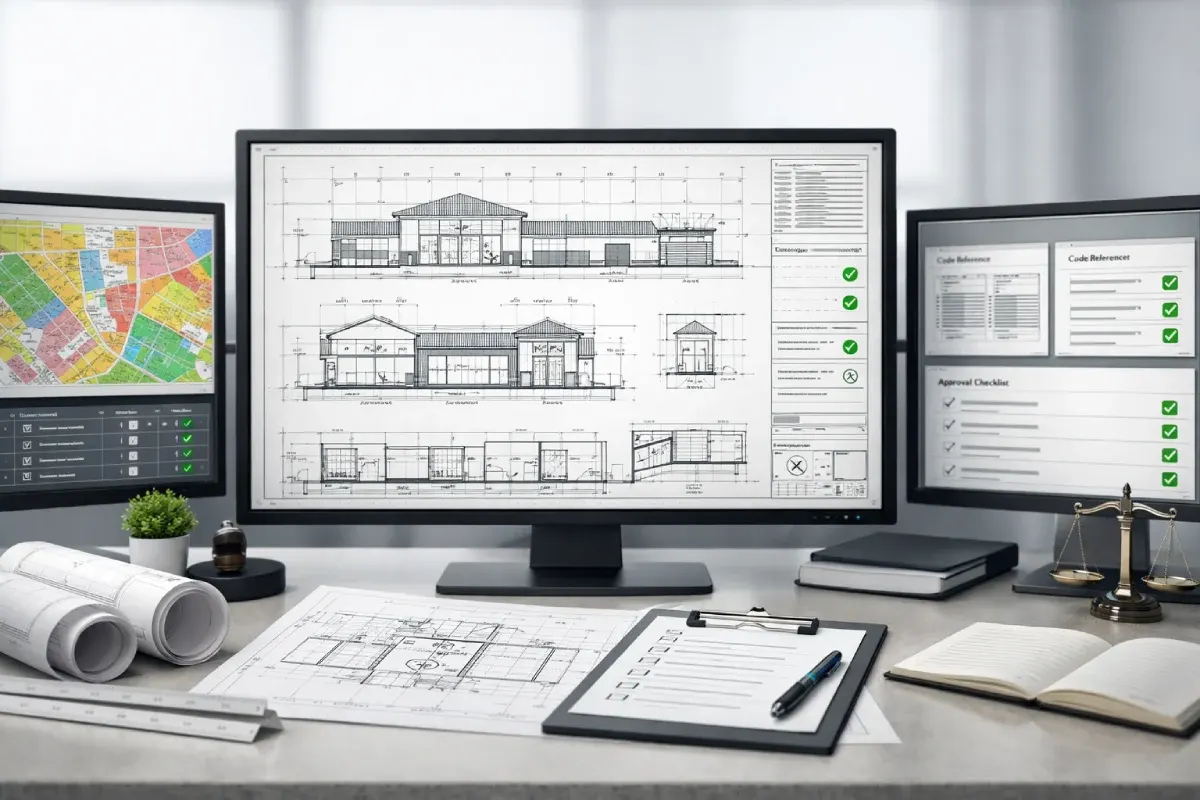
When those two forces collide — and they always do — the wrong architecture firm will either compromise your brand to satisfy the municipality or delay your opening trying to force a non-compliant prototype through the process. The right firm has already solved this problem systematically.
This guide explains what local adaptation actually means in franchise architecture, how specialized firms solve it, and the five questions you should ask before signing an architecture agreement.
What Does 'Local Adaptation' Actually Mean in Franchise Architecture?
Local adaptation is not redesigning your brand for every new market. It is the structured process of modifying site-specific and jurisdiction-specific elements of a prototype while leaving brand-defining elements untouched.
In practice, local adaptation covers three categories:
- Jurisdictional requirements: Building codes, fire egress rules, ADA interpretations, and energy codes that vary by state and municipality.
- Site-specific conditions: As-built conditions, demising walls, structural constraints, and utility configurations that differ from the prototype baseline.
- Climate and regional factors: HVAC load calculations, exterior material performance, and accessibility ramp grades that differ by geography.
None of these should touch the elements that carry your brand: the entry sequence, material hierarchy, signage placement, lighting strategy, or the spatial proportions that make your locations feel consistent to customers.
A firm without a franchise-specific system will blur this line. A specialist firm builds the line into its process from day one.
Why Generalist Firms Struggle With Franchise Architecture
Most commercial architecture firms are skilled at designing individual locations. Franchise architecture is a different discipline. The firm is not designing one building — it is designing a system that can be deployed dozens or hundreds of times, each time in a different jurisdiction, each time on a site the firm may not have seen before.
Generalist firms typically fail franchise clients in three specific ways:
- No prototype framework: Without a prototype as the starting point, every new location is essentially a custom project. That means full design fees, longer timelines, and inconsistent brand expression — every time.
- No jurisdiction overlay system: Each AHJ has specific requirements for submittal format, drawing content, fire safety documentation, and accessibility compliance. Firms without an overlay system rebuild this knowledge from scratch on each project, burning time and creating errors.
- No separation of brand non-negotiables from adaptable elements: Without a documented distinction between what cannot change and what can, design teams make brand decisions based on what is easiest to permit — not what is right for the brand.
How a Specialized Franchise Architecture Firm Solves This
The best architecture firms for franchise brands have built internal systems that mirror how franchise development actually works.
The Prototype as the Adaptation Framework
The prototype is not just a design package. It is the master document that defines what every location should look like, contain, and perform. A well-built prototype includes a complete set of construction documents, a materials and finishes schedule, life safety and code documentation, a consultant coordination matrix, and — critically — a documented list of which elements are brand standards versus which are site variables.
When a new location enters the pipeline, the firm adapts the prototype to the site, not the other way around. That distinction protects brand equity at scale.
The AHJ Overlay System
Specialist firms maintain a jurisdiction knowledge base that covers permit submittal requirements, AHJ-specific drawing standards, energy code variations, and fire marshal preferences across every market where they operate. When a new market is entered, the firm applies the relevant overlay to the prototype package rather than researching requirements from scratch.
This system reduces permit rejections, shortens the permit cycle, and allows a firm to open in a new state without treating it as an exploratory project.
The Brand Standards Matrix
The most capable franchise architecture firms operate with a documented matrix that separates brand non-negotiables from adaptation variables. This matrix is built in collaboration with the franchisor and governs every design decision during the adaptation process.
Brand non-negotiables might include the entry sequence, the specific lighting scheme at the service counter, the material specification for branded millwork, and the spatial proportion of the main customer-facing zone. Adaptation variables include structural system response, mechanical routing, ADA-compliant path of travel modifications, and exterior facade treatment where local codes require deviation.
5 Questions to Vet an Architecture Firm for Franchise Work
These questions cut through marketing language and surface how a firm actually operates:
- 1. Do you work from a prototype, and is the prototype yours to own? You should own the prototype documents. If a firm retains ownership, you are locked in forever.
- 2. Are you licensed in the states where we plan to open? Multi-state licensure is not optional — it is a legal requirement. Ask for the complete list of licensed jurisdictions, not a general claim.
- 3. How do you handle AHJ variations without redesigning the location? The answer should describe a specific system — overlay documentation, jurisdiction-specific packages, or a pre-permit AHJ consultation process. A vague answer is a red flag.
- 4. What is your process for separating brand standards from site adaptations? There should be a documented process involving brand standards review, not a verbal commitment.
- 5. Can you show us timelines and permit outcomes across multiple markets? Track record matters. Ask for permit turnaround times, resubmission rates, and opening timeline performance across comparable clients.
What Brand2Builds Brings to Franchise Architecture
Brand2Builds is a specialized franchise architecture firm with 20+ years of experience, nationwide licensure, and a client portfolio that includes Capital Tacos, The Great Greek Mediterranean Grill, The DripBar, Scenthound, and dozens of other growing multi-unit brands.
Our approach is built on three systems: a prototype-first design process, a jurisdiction overlay database covering all 50 states, and a brand standards matrix developed in collaboration with each franchisor. Every location we deliver is compliant, consistent, and contractor-ready — regardless of market.
Ready to scale your franchise with architecture built for consistency and speed? Brand2Builds has 20+ years of experience and is licensed in all 50 states. Contact us at brand2builds.com or call (1) 305 407 3514.
Frequently Asked Questions
What is local adaptation in franchise architecture?
Local adaptation refers to modifying site-specific and jurisdiction-specific elements of a franchise prototype to meet local building codes, ADA requirements, and site conditions — while preserving all brand-defining design elements.
Can any architecture firm do franchise work?
Technically, yes. In practice, firms without franchise-specific systems — including a prototype framework, AHJ overlay database, and brand standards matrix — produce inconsistent results, longer timelines, and higher per-location costs.
What is an AHJ overlay in franchise architecture?
An AHJ (Authority Having Jurisdiction) overlay is a jurisdiction-specific documentation layer applied to a prototype package that addresses local permit submission requirements, drawing standards, energy codes, and fire safety documentation. Specialist firms maintain overlay libraries for every state and major municipality.
Do I need an architecture firm licensed in every state where I plan to open?
Yes. Architecture is a licensed profession, and a licensed architect of record must be on file in each jurisdiction where a permit is pulled. Firms with nationwide licensure can provide this without requiring you to retain separate local architects.