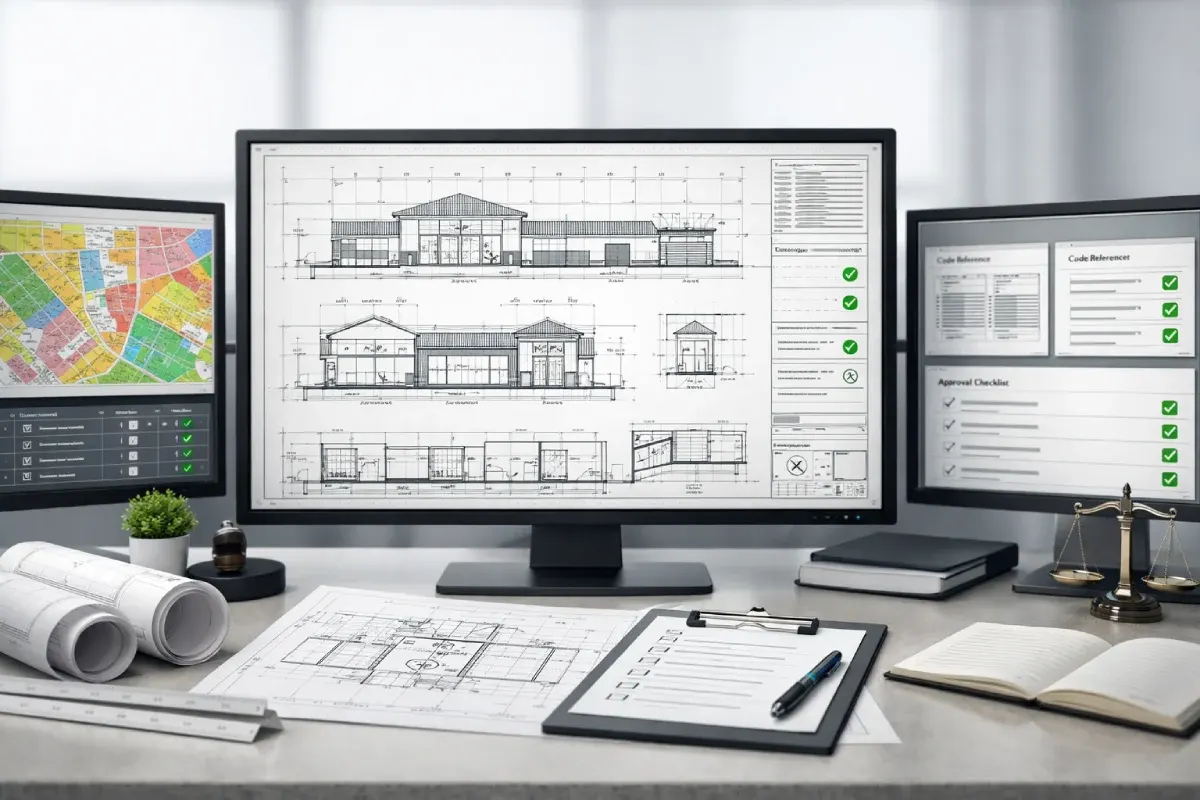
A full-service rollout management partner takes end-to-end accountability for the franchise rollout process ,from prototype adaptation through final punch list. They are the single operational entity responsible for design, permitting, procurement, construction coordination, and quality compliance across every unit in your pipeline.
What 'Full-Service Rollout Management' Actually Means
The term is used loosely. True full-service rollout management means:
- Design and documentation: Prototype adaptation and permit-ready drawing production for each new location
- Permitting management: AHJ engagement, submission coordination, revision response, and approval tracking across all active markets
- Procurement coordination: Long-lead material ordering, vendor management, and supply chain risk mitigation
- GC qualification and oversight: Contractor selection, bidding management, contract administration, and performance accountability
- Construction administration: Active field oversight, RFI management, change order control, and milestone verification
- Brand standards compliance: Design review at key construction milestones, deviation tracking, and final sign-off
- Reporting and program management: Executive-level reporting on project status, schedule performance, and budget variance across all active units
Firms that do some of these things , but not all , are not full-service. They require the client to manage the coordination between them. That coordination burden is itself a cost, a risk, and a time constraint on your internal team.
How to Assess Full-Service Rollout Capability
Operational Scope Questions
'What does your firm own end-to-end, and what do you subcontract?' The answer reveals the actual boundary of accountability. A firm that designs in-house but hands off construction management to a third party has a seam in their delivery model — and that seam is where problems are born.
'How do you structure the team for a multi-unit program? Who is the day-to-day point of contact?' Ask for the organizational chart: who is the program director, who are the project managers per region, what is the team-to-unit ratio. A firm managing 30 active units with two project managers is understaffed.
'How do you coordinate design, permitting, and construction simultaneously across multiple active units?' Listen for a systems-based answer: a project management platform, a standardized phase-gate process, a reporting cadence. If the answer is 'we have experienced people who manage it,' the systems don't exist.
Speed and Throughput Questions
What is your average design-to-permit-submission cycle for a prototype adaptation? Best-in-class: 4-6 weeks. Acceptable: 6-8 weeks. A firm that cannot commit to a specific timeline is not optimized for rollout velocity.
What is your largest single-year rollout volume? Tell me about the logistics of managing that program.' Look for specifics: how many units, how many markets, what team structure, what coordination systems. Generic answers about 'extensive experience' without operational detail are a warning sign.
How do you handle permitting delays without stalling the rest of the rollout pipeline? The answer should describe a parallel-processing approach where permitting delays on one unit don't cascade to others, and where risk mitigation measures are pre-built into the process.
Brand Standards and Quality Questions
'How do you enforce brand standards compliance across multiple GCs in different markets?' The answer should describe: documented specifications, pre-qualification requirements, milestone reviews, and a documented consequence for non-compliance.
'What happens when a GC makes a substitution in the field without approval?' This question surfaces the actual governance culture of the firm. The right answer describes an immediate escalation process, a formal variance review, and a documented record.
What to Look for in a Rollout Partner's Track Record
- Portfolio at scale: How many locations has the firm delivered for a single client across a continuous rollout program? Thirty locations over two years is a rollout program. Ten locations over five years is not.
- Multi-market experience: Has the firm managed permitting and construction simultaneously in multiple states or jurisdictions? Each new jurisdiction introduces regulatory variability that an inexperienced firm will absorb as delay.
- Repeat client rate: Rollout programs that go well create long-term relationships. A high repeat client rate is evidence that execution matches the promise.
- Timeline and budget performance data: Ask for actual performance data against committed schedules and budgets across their rollout portfolio. Not case studies — data.
Why Fragmented Delivery Fails at Scale
The alternative to a full-service rollout partner is managing the rollout yourself — coordinating between an architecture firm, a permitting consultant, a procurement team, a construction manager, and individual GCs in each market.
For operators expanding at 5-10 units per year, that model is manageable. Above that threshold, the coordination overhead consumes your internal team's capacity, creates communication failures between fragmented parties, and produces inconsistent results because no single entity is accountable for the whole.
The math is direct: at 30+ units per year, the management capacity required to coordinate fragmented service providers is the equivalent of a full internal construction department. For most franchise organizations, hiring that internal team is more expensive and less effective than a full-service rollout partner who already has the systems, the relationships, and the operational track record.
How Brand 2 Builds Delivers Full-Service Rollout Management
Brand 2 Builds was structured from the ground up to function as a full-service rollout partner for multi-unit brands. Our model eliminates every coordination seam in the delivery process:
- We design the prototype and the adaptation documentation using BIM-native workflows that produce permit-ready drawing packages in 4-6 weeks from site confirmation. We own the prototype and all documentation — there's no external design firm managing version control.
- We manage permitting as a core competency, maintaining active relationships with AHJs across Florida's primary markets and developing jurisdiction-specific submission packages that consistently move through review faster than generic submissions.
- We pre-qualify and manage construction delivery with active field oversight, managing RFIs and change orders, and holding contractors accountable to schedule, budget, and brand standards at each milestone.
- We enforce brand standards at every stage — reviewing drawings before permit submission, conducting mid-construction site inspections before finishes are installed, and completing a final compliance review before sign-off.
- We report at the executive level, giving franchise executives real-time visibility into unit-level schedule and budget status across the entire active pipeline.
We have delivered multi-unit rollout programs for franchise brands across commercial, retail, and food service categories — managing simultaneous active pipelines across Florida and supporting national expansion into adjacent markets. Our clients return to us for subsequent expansion phases because the first program performed.
Contact Brand 2 Builds to evaluate whether our full-service rollout management capability fits your next expansion phase. We'll walk you through our operational model, share our performance data, and discuss how our delivery infrastructure maps to your program's specific requirements. [ Schedule a Rollout Capability Evaluation → brand2builds.com ]
Internal Linking Suggestions
- The Velocity Framework: Reducing Lead Times and Risk in National Rollout Cycles
- Selecting a Strategic Partner for National Prototype Franchise Rollouts
- Unit Economic Impact of Store Prototypes for Multi-Unit Scale
- Finding the Right Multi-Site Brand Identity Partner for Franchise Consistency
- Protecting Brand Equity: Managing Physical Brand Identity Systems in Rapid Growth