
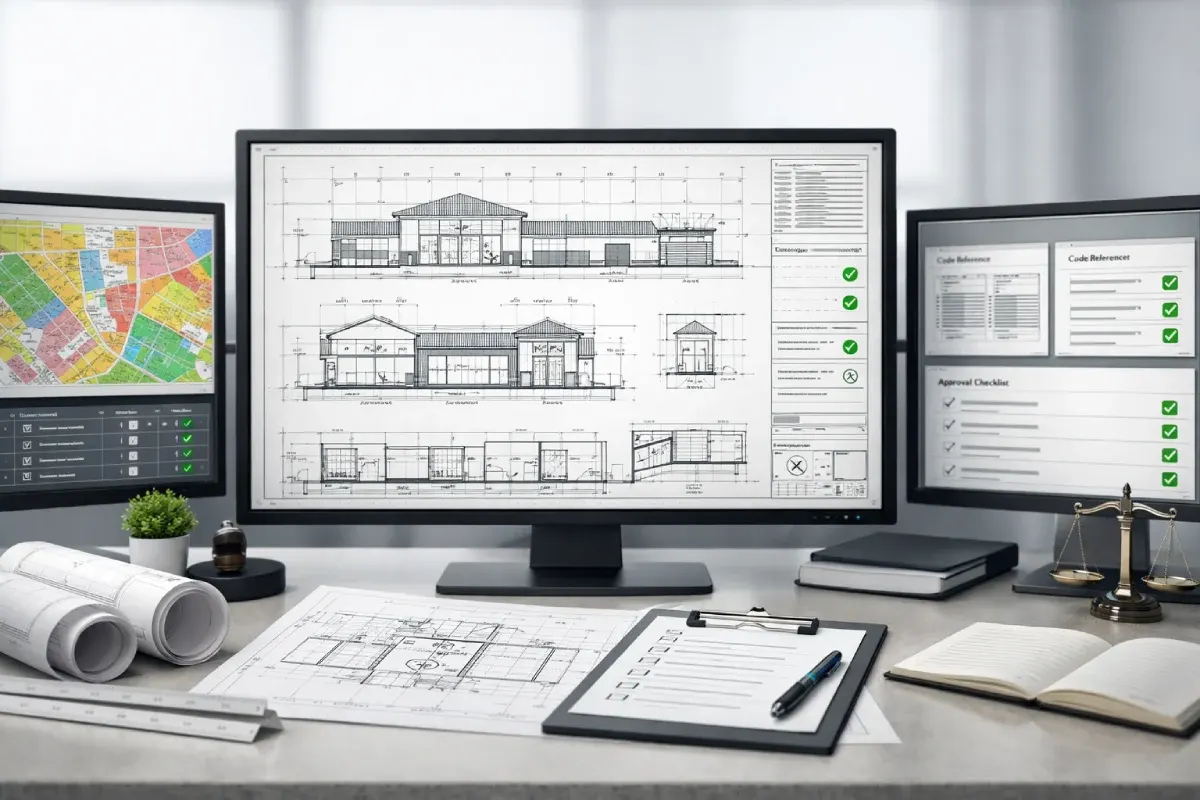
If your brand has an approved prototype and five or more units open or in development, you have probably noticed the pattern. Every new city or county sends back a different set of comments, and each new jurisdiction starts to feel like a fresh design job. The architect bills for another round of revisions, the lease-to-opening date slides, and rent keeps running on an empty space.
A franchise code compliance matrix does not guarantee approval anywhere. What it does is give the brand institutional memory. Every lesson a jurisdiction teaches you becomes a reusable rule instead of a one-off fix, and the prototype evolves as one coherent system rather than a pile of local exceptions.
Why One Prototype Gets Different Answers in Different Places
The prototype is the same set of drawings. The rules it is measured against are not. Several layers change from one jurisdiction to the next:
- Adopted code editions. Jurisdictions adopt model building codes on their own schedules, so two neighboring counties can be reviewing against different editions.
- Local amendments. Many jurisdictions modify the model code, sometimes in ways that affect plumbing fixture counts, egress, or fire protection.
- Energy requirements. Envelope, lighting, and mechanical efficiency rules vary by state and sometimes by city.
- Accessibility. Federal standards set a baseline, and some states layer their own accessibility requirements on top. Our upcoming ADA guide covers this in detail.
- Fire and life safety. The local fire marshal may interpret sprinkler, alarm, and hood suppression requirements differently from the building department.
- Health department review. Food service concepts face a separate review with its own expectations for sinks, finishes, and equipment.
- Zoning and signage. Use permissions, parking, and storefront signage often sit with a different office entirely.
We have covered the broader question of adapting a prototype to local conditions in our article on local adaptation. The problem here is narrower: what happens to all the knowledge your team gains each time it goes through that adaptation.
What the Matrix Is and How It Is Structured
Think of the matrix as a grid. Each row is a prototype element that tends to draw comments. Each column captures what you know about how a specific jurisdiction treats that element. Typical rows include egress, restroom count and fixtures, hood and makeup air, fire protection, accessible route, storefront, and mechanical and energy systems.
The columns should answer the questions your team will ask later:
- Jurisdiction: the city, county, or authority having jurisdiction.
- Code edition: which edition was in force when the project was reviewed.
- Local amendment: whether a local change applied, described in plain language.
- Classification: brand-critical (do not change) or adaptable (can flex).
- Approved response: what the brand actually built or submitted that was accepted.
- Source: the code provision, reviewer comment, or correspondence behind the requirement.
- Date verified: when someone last confirmed the entry is current.
Example only: an excerpted matrix for an illustrative restaurant prototype. Jurisdictions are placeholders and no specific code provisions are implied.
| Prototype element | Jurisdiction A | Jurisdiction B | Jurisdiction C |
|---|---|---|---|
| Restroom count | Prototype layout accepted as drawn | Reviewer required an additional fixture based on calculated occupant load; adaptable | Accepted; state accessibility review added clearance changes |
| Kitchen hood and makeup air | Accepted as drawn | Fire marshal requested revised suppression documentation; adaptable | Mechanical reviewer required a separate makeup air calculation |
| Egress | Accepted as drawn | Accepted as drawn | Second exit location questioned because of the tenant space depth; brand-critical dining layout preserved by relocating back-of-house door |
How to Build a Code Matrix in Five Steps
- Audit previously approved permit sets. Pull the permit drawings and correction letters from every location you have opened. Approved sets are your most reliable record of what each jurisdiction accepted.
- Sort every change into three buckets. Brand non-negotiable, adaptable, or jurisdiction-mandated. This sorting is where most of the value comes from, because it forces a decision about what the brand is willing to flex.
- Log each change with the comment that triggered it. Record the reviewer's wording, not just the fix. The comment is what you will search for the next time a similar note arrives.
- Assign an owner and an update cadence. Someone at the franchisor level needs to be accountable for keeping entries current. Without an owner, the matrix becomes one more outdated file.
- Feed recurring patterns back into the base prototype. If three jurisdictions ask for the same change, it may belong in the prototype itself. This is how the matrix reduces future redesign rather than only documenting it.
How Brand2Builds Helps
Brand2Builds adapts franchise prototypes to each jurisdiction under multi-state licensure and produces permit-ready documentation for every location. As we work across markets, we can help you capture what each jurisdiction required and why, so those lessons carry forward to the next submission instead of being rediscovered.
An Illustrative Example Across Three Jurisdictions
Consider an illustrative fast-casual restaurant prototype opening in three jurisdictions in the same year. In the first, the permit set goes through largely as drawn. In the second, the reviewer calculates a higher occupant load for the dining area and asks for an additional restroom fixture, and the fire marshal wants more detail on the hood suppression system. In the third, a deeper, narrower tenant space raises a question about the location of the second exit.
Without a matrix, each of these gets solved by whoever is working on that project. The second jurisdiction's fixture solution lives in one architect's files. The third jurisdiction's egress fix is known to one project manager. Twelve months later, a new market sends back the same occupant load comment and the team starts from scratch.
With a matrix, each fix is logged against the prototype element, classified, and tied to its source. When the next submission is prepared, the team can see that dining-area occupant load has drawn comments before, check the new jurisdiction's approach in advance, and decide whether the prototype should simply carry the extra fixture going forward.
How the Matrix Cuts Predictable Correction Comments
Most correction comments on a mature prototype are not surprises. They are repeats of something the brand has seen before in another market. The matrix turns those repeats into a pre-submission self-check: before a set goes out, the team reviews each flagged element against what is known about the target jurisdiction and addresses likely comments up front.
This will not eliminate plan review comments, and it should not be sold internally as a way to do so. What it does is shift effort earlier, when a change costs a drawing revision rather than a resubmittal cycle and a delayed opening. It also gives the brand a consistent answer when a franchisee or local architect asks why the set looks the way it does.
Signs Your Brand Needs a Code Matrix
- The same reviewer comment appears in multiple markets.
- Franchisees or local architects regularly ask for the "latest set."
- No one can say with confidence which version of the prototype went to which city.
- Local architects solve the same problem in different ways from project to project.
- Redesign fees show up on most new locations, not just unusual ones.
- Corporate cannot answer "what did we change in that market, and why?"
If two or more of these sound familiar, the problem is usually not the prototype. It is that the knowledge generated by each permit is not being kept anywhere the next project can find it.
Who Should Own the Matrix
The matrix belongs at the franchisor level, because the franchisor owns the prototype and the brand standards it protects. If ownership sits with individual franchisees or local architects, the matrix fragments into the same collection of exceptions it was meant to replace.
That does not mean the franchisor fills it in alone. The architect of record on each project is the best source for what a jurisdiction required and how it was resolved, and the matrix should make it easy for them to submit that information at project closeout. A practical split looks like this:
- Franchisor development or construction team: owns the matrix, decides classifications, approves prototype changes.
- Architect of record: reports jurisdiction requirements, reviewer comments, and approved responses for each location.
- Franchisee: flags local issues early and uses the current prototype version the franchisor provides.
One caution: the matrix is an internal planning and governance tool. It is not legal advice or a compliance determination, and entries should be verified against current official sources before they are relied on for a new submission. Our permits-by-state article is a useful starting point for understanding how requirements differ.
Frequently Asked Questions
How often should a franchise code matrix be updated?
Update it based on triggers rather than a fixed calendar. The main triggers are a jurisdiction adopting a new code edition, the brand entering a new market, a recurring comment appearing in a new location, and any change to the base prototype. Every entry should carry a date verified so the team can see what may be stale before relying on it.
Who is responsible for local code compliance, the franchisor or the franchisee's architect?
Responsibility is shared, and the exact split depends on contracts and licensure. The licensed architect of record is typically responsible for the construction documents submitted in a given jurisdiction. The franchisor is responsible for the prototype and brand standards it provides. The franchisee is often the permit applicant. Clear contract language and a shared matrix help each party understand where its role starts and stops.
Can a code matrix replace local plan review?
No. The authority having jurisdiction always makes the final decision, and reviewers can interpret requirements differently from one submission to the next. A matrix reduces surprises by preparing the team for likely comments, but every location still goes through full local review.